ESTUARY EXPERTS

ESTUARY EXPERTS

Wednesday, July 6, 2016

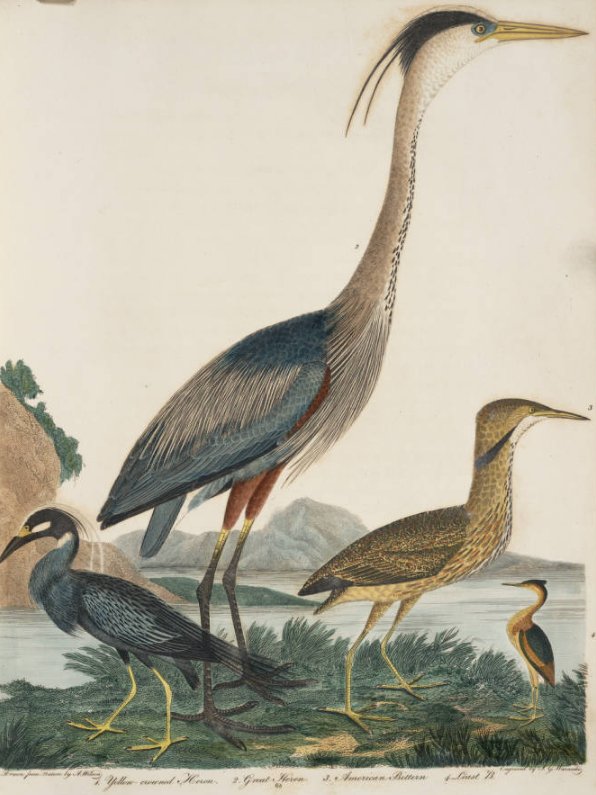
Alexander Wilson ( 1766): The Great Heron from American Ornithology.


One last bit of from Alexander Wilson (b. 1766): The Great Heron from American Ornithology.


Friday, May 27, 2016

Killer Nile Crocodiles in Florida


 05_25_Nile_crocodile_Florida

Killer Nile crocodiles in Florida? Experts say it's possible


FORT LAUDERDALE, Fla. (AP) —

Step aside, Burmese python — you may no longer be Florida's scariest invasive species.

Researchers have confirmed that three Nile crocodiles were captured near Miami, and they say it's possible more of the man-eating reptiles are still out there, although no one can say for sure.

The big question now: How did they get to Florida?


"They didn't swim from Africa," University of Florida herpetologist Kenneth Krysko said. "But we really don't know how they got into the wild."

Krysko and his co-authors just published a paper showing that DNA testing proved the three animals captured in 2009, 2011 and 2014 are Nile crocs, a species whose males grow to over 16 feet long and weigh upward of 1,600 pounds. Nile crocs are believed to be responsible for up to 200 fatalities annually in their native sub-Saharan Africa. Compare that with an annual average of six reported shark attack deaths globally.

Krysko, who works at UF's Florida Museum of Natural History, said the captured crocodiles matched genetically, meaning they are related to one another, but didn't match Nile crocs kept at Disney's Animal Kingdom and other licensed Florida attractions. That means the crocs probably were brought to Florida illegally by an unlicensed reptile collector who either didn't contain them properly, allowing them to escape, or, more sinisterly, planted them in the Everglades in hopes they would multiply.

The Nile croc, if it became established in the Everglades, would pose another invasive threat to its teetering ecosystem. Through crossbreeding, they could endanger the smaller, less aggressive American crocodiles, which have never been responsible for a confirmed human death in the U.S. About 1,000 American crocodiles live in South Florida, mostly in mangroves and estuaries. Any hybrids would degrade the genetic integrity of the endangered American variety.

Nile crocs also are known to attack livestock, which would be bad news for cattle farms that border the Everglades.

Krysko and two co-authors, independent wildlife biologist Joe Wasilewski and UF wildlife ecology professor Frank Mazzotti, think more Nile crocs lurk unfound in the Everglades, but they aren't certain.

Allyson Gantt, a spokeswoman for Everglades National Park, where one of the reptiles was found, disagrees, saying no Nile crocs still roam the park.

Some Everglades visitors might not be aware of the differences between crocodiles and alligators, complicating efforts to confirm any remaining crocs. Crocodiles have angular snouts, and their lower teeth are exposed when their mouths are closed. Alligator snouts are rounded, with few exposed lower teeth. Nile crocs are usually bronze or brownish yellow; alligators are blackish green.

Wasilewsi said people are likely to notice the difference, or at least take photos that researchers can check later. And no, crocs and alligators can't interbreed.

Florida already has more non-native amphibians and reptiles than any region worldwide, according to the UF paper, published April 30 in Herpetological Conservation and Biology. They include Burmese pythons, a menace that quickly reproduced into the thousands and is decimating the Everglades' small mammal population.

Giant toads, iguanas and another species of crocodilian, the spectacled caiman, also live in the state. But that species grows to only about 80 pounds and feeds on fish, crustaceans and the occasional small mammals.

All three Nile crocodiles were captured in extreme South Florida.

— The first, a hatchling, was found on a front porch and sent to a Louisiana reptile exhibit.

— The second, a female measuring 4 feet, was captured at a park. Wasilewski kept it, but later gave it to another licensed researcher.

— The third was captured twice. The first trapper didn't have the proper permit, so he released the female. The croc was recaptured two years later 18 miles away by water in Everglades National Park. It was euthanized.

The UF paper said all Florida wetlands and coastal areas of Alabama, Mississippi, Louisiana and Texas would be hospitable to Nile crocodiles. They require fresh water, abundant prey and year-round warm weather.

"Doesn't that sound like Florida?" Krysko said.

Fortunately, Nile crocodiles don't reproduce rapidly. Still, the researchers said, it might only take one adult male and female finding each other for an Everglades population to become established.

"I have two words: Burmese python," Wasilewski said. "If you would have told me 15 years ago we would have an established population in the Everglades, I wouldn't have believed you."


Follow Terry Spencer on Twitter at —https://twitter.com/terryspen.
His work can be found at —http://bigstory.ap.org/author/terry-spencer.

Thursday, May 26, 2016

Eyelids of the Morning book trailer


Published on Jun 22, 2013
Buy it now! http://heidipeltier.wix.com/squalo

Follow Heidi Peltier on facebook and twitter.


Ethan is a sixteen-year-old boy who, with his twelve-year-old brother Rory,
reluctantly leaves his boarding school for the summer to be dragged to
the other side of the world by their reclusive and eccentric uncle. When
their uncle finally explains that he is hunting for a true, living
dinosaur in the heart of the Congo River basin, Ethan immediately pegs
him for a lunatic. However, using documented eyewitness accounts, a
vivid description of dinosaurs from the Bible, and, his most powerful
weapon, news that Ethan and Rory's late mother believed that dinosaurs
exist too, their uncle has them convinced. They journey to the Congo and
meet Shari, a missionary nurse, and her adopted daughter Maggie whose
passion for the plight of the Congolese people leaves Ethan instantly
smitten. Their dinosaur hunt leaves Ethan, Maggie and Rory separated
from their group, facing danger at every turn, and racing against the
clock to get medical help for a serious injury. In the end, they make
the discovery and sacrifice of a life time, the emotional gap between
the boys and their uncle is finally bridged, and Ethan learns that home
truly is where the heart is.


Saturday, April 30, 2016

Gator Mom vs. the World


Watch
how this protective alligator mother uses her "jaws of love" to protect
her newborns from the dangers that lurk in the Florida Everglades.
Link: https://youtu.be/IPTs2Nz3eA0


Since today is Mother’s Day, here’s a look at the spectrum of
mother and offspring relationships on our planet. While humans are fond
of baby wraps, backpacks and strollers, other species have their own creative ways of transporting their young.
  • American alligator mothers often help their babies move around
    by letting them ride on their heads or sometimes even giving them a lift
    in their mouths.
  • Wolf spiders actually carry their egg sacs around with them and when
    the baby spiders hatch, they climb onto their mother’s abdomen for the
    first few days before heading off to live on their own. One Australian discovered this the hard way. [VIDEO]
  • This species of toad in South America embeds her fertilized eggs into her back. When they hatch, the tadpoles literally come out of her skin. [VIDEO]
  • Everyone’s favorite baby transporter, the kangaroo, has its famous stomach pouch, but I bet you didn’t know that baby kangaroos blindly crawl along their mother’s body from her uterus to the pouch right after birth. [VIDEO]
If that’s not enough of an animal fix for you, here’s a photo album from National Geographic of mothers and babies from across the animal kingdom.
And now for the rest of the week’s geek:
@Summer_Ash, In-house Astrophysicist


Tuesday, April 12, 2016

Hunters are killing huge Gators

Alabama hunters are killing huge gators off the Gulf Coast. 

Is that a good thing?

 
He was a whopper.

It took six men to pull a 13-foot, 9-inch alligator from Lake Eufaula in Alabama. The animal weighed in at 920 pounds at a local lumber yard in mid-August, but its girth is only now raising eyebrows and drawing gasps; it was weighed last week but started to draw national attention Tuesday.

The giant male gator is one of several monsters that were hauled out of waters during regulated hunts in Alabama, Texas and Florida in recent years, and some biologists question whether that’s a good thing
 
Big dominant males manage the habitat where they reside, keeping smaller, more aggressive males away.

“You move one animal and four or five or six smaller gators come in and fight for territory,” said Kent Vliet, an alligator biologist at the University of Florida.
. “It is a bit destabilizing in that sense.”
 
Vliet said alligator hunters should be encouraged to snag younger males to manage populations and leave the behemoths alone.

“In my mind, because so few alligators that hatch reach adult size, and even fewer reach full bull status, I think of those animals as being very valuable,” said Vliet, coordinator of the university’s laboratory in the biology department. “A lot of ecological resources have gone into making that animal. To me that’s sort of a waste.”


Humans don’t hunt that way.

[New study shows just what vicious predators humans really are]

They want the big game, the big trophy, a place in the record books. 
Scott Evans, of Center Point, and his friends, brothers Jeff and Justin Gregg, achieved that in some regard, capturing the biggest gator ever in that particular lake.

But as gators go, this beast was no state or national record. 
 
The largest alligator ever caught in the wild was a 15-foot, 9-inch giant wrangled last year in a tributary to the Alabama River.

More than likely, the world record 1,011-pound male would have dominated the more recent catch in Lake Eufaula. He probably wouldn’t have allowed him in his territory, and in the unlikely event that he did, he definitely wouldn’t have allowed him to approach females during the April to May breeding season, Vliet said.


The second largest catch, a 14-foot, 8-inch gator roped and drowned by Thomas Bass of Trinity, Tex., held the record until Mandy Stokes and a group of helpers made news with their catch last year. Bass caught his gator eight years ago, but wasn’t entered into the record kept by Safari Club International until last year.

Robert “Tres” Ammerman, a licensed practical nurse from Apopka, caught a skinny 14-foot, 3-inch male that weighed 654 pounds, in Lake Washington in 2010. It was the longest documented gator caught in Florida, according to the state Fish and Wildlife Conservation Commission.

Florida is renowned for alligators, which serve as the mascot for the state’s largest university, but the animals range the entire length of the Gulf Coast. They are also found in the Carolinas.


The American alligator is classified as threatened by the U.S. Fish and Wildlife Service, a listing that provides federal protection, But state approved management and control efforts are allowed under the designation.

Louisiana and Florida have the largest habitats, but the populations are rapidly growing in Alabama, Mississippi and Texas, Vliet said. With smaller habitats in the latter three states, population management programs were slower to start. 


[Frog, toad and amphibian populations are plummeting]

“Because they delayed the annual harvest for so long, they’ve had some very big animals,” Vliet said.
Removing them makes headlines, but the news is not always good, especially when no human has been harmed. “These are unusual animals. They have survived a long time. They tend to be wary animals. They may be older animals. It is likely that they do dominate an area, subordinate smaller males, mate with multiple females,” Vliet said.

“In a lot of ways they control the alligator population in that area. There’s no doubt in my mind that when you move an animal of this size, it has an impact on the population.”


Read more:
Global warming worsened the California drought, scientists say
Bad parenting? Baby zebra finch look for better role models
Drought: The big fish story no one is talking about
This invasive giant snail is spreading in Florida

Darryl Fears has worked at The Washington Post for more than a decade, mostly as a reporter on the National staff. He currently covers the environment, focusing on the Chesapeake Bay and issues affecting wildlife.


 Link: https://www.washingtonpost.com/news/energy-environment/wp/2015/08/25/hunters-are-killing-huge-gators-on-the-gulf-coast-is-that-a-good-thing/


Friday, March 11, 2016

REPTILE GALLERY - NHM


A to the time before the dinosaurs (were in our Reptiles Gallery) - crocs dominate in Nov 1889


This raccoon is the oldest member of our Spirit Collection, from 1730. See it on a BTS tour http://www.nhm.ac.uk/visit/whats-on/programs/nhm/behind-the-scenes_spirit_collection_tour.html 
 
 
This raccoon is the oldest member of our Spirit Collection, from 1730. See it on a BTS tour


x

Wednesday, November 4, 2015

Crocodile Threat


http://www.news.com.au/technology/science/northern-territory-crocodile-threat-revealed-at-inquest/story-fnjwkt0b-1227592870284?sv=7b0b16d80f70e292b02d5121461bbd6


Northern Territory crocodile threat revealed at inquest

The heads of the crocodiles that killed William Scott (left) and Lanh Van Tran (right) sat in the courtroom during the inquest.
Andrew Koubaridis news.com.au 


CROCODILES in Northern Australia are getting bigger, are “showing no fear” of humans and are brazenly jumping at boats, according to inquest findings of two fatal attacks.
One case is believed to be the first time a crocodile has launched out of the water and killed someone on a boat, by taking him in his jaws.
The second involved a monster nicknamed ‘Michael Jackson’, who dragged a fisherman to his death by his outstretched arm. His wife gave traumatic evidence that he cried “Oh my god, I am dead” when he realised what was about to happen.
In the first attack examined by the inquest, 62-year-old Bill Scott was fishing with his wife Roslyn, son Aaron and friends on a Top End waterway in June 2014 when the unprecedented attack occurred.
Mr Scott was standing in his three-and-half-metre dinghy when a crocodile launched itself out of the water and locked its huge jaws around his left arm, shoulder and chest and dragged him into the water.
Mrs Scott was in the boat with him and told the inquest he had a “confused” look seconds before the attack — which is believed to be the first time a crocodile has attacked someone on a boat in the Territory.
The croc bumped into the boat first, causing Mr Scott to steady himself. But neither he or his wife could have predicted the horror that was about to unfold.
“This thing just came up from behind the motor and grabbed him And that was it,” Roslyn Scott said. “He was gone.”

Bill Scott was killed by a saltwater crocodile that launched out of the water and dragged him off the boat he was in.
Bill Scott was killed by a saltwater crocodile that launched out of the water and dragged him off the boat he was in.Source:Supplied
She told the inquest the attack was so quick he couldn’t say anything and there was nothing they could do to help. There was no splashing, he simply disappeared with the crocodile into the murky brown water.
His body did float to the surface about 15 minutes later but it couldn’t be retrieved. Police and rangers later recovered his remains, counting an astonishing 23 crocodiles lurking nearby.
A large crocodile was shot the next day and its stomach was cut open. “Most of the deceased was located in the stomach of the crocodile, the only notable omissions being Bill’s left arm and clothing,” Gary Lindner, a veteran Kakadu Park Ranger, said in evidence.
The inquest, before Coroner Greg Cavanagh, also examined the death of a second fisherman, Lanh Van Tran, 57, who was attacked two months after Mr Scott on the banks of the Adelaide River.
Mr Van Tran saw his killer approaching but could do nothing to save himself.
He called out “Oh my god, I am dead” in Vietnamese just before he was dragged into the water by his left arm.
He had waded into three metres of mud that separated the water and riverbank to try and unsnag the fishing line when the crocodile struck.

Lanh Van Tran died in a horrifying crocodile attack. Picture: Nine news
Lanh Van Tran died in a horrifying crocodile attack. Picture: Nine newsSource:Supplied
The 4.5-metre half-albino crocodile locals called 'Michael Jackson' that killed Mr Van Tran. Picture: Adelaide River Queen Cruises
The 4.5-metre half-albino crocodile locals called 'Michael Jackson' that killed Mr Van Tran. Picture: Adelaide River Queen Cruises Source:Supplied
His wife Thi Ban Le turned and saw a crocodile tail turn in the air. She ran to the water to help but could find no sign of her husband, having hoped to find him tangled with the fishing line.
She then drove to a nearby property to get help.
The croc that killed Mr Van Tran was later identified as one dubbed “Michael Jackson” — a big animal known in the area for its distinctive albino head and popular with tourists. Rangers caught it later that night with a spotlight with a hand and part of an arm in its mouth.
His left leg was found in its stomach with the rest of Mr van Tran’s body discovered nearby.
In his recently released findings, Coroner Greg Cavanagh said the sizes of crocodiles had continued to increase, as their numbers flourished since they become protected in 1971.
One theory advanced at the inquest, that was supported by rangers called to give evidence, was that the crocodiles were gorging themselves on the feral animals in Kakadu.
That meant the danger was greater now than ever.
“What is different from any other time is that since protection in 1971 crocodiles have become familiar with humans and boats and generally have not developed the fear of humans that once existed when humans were also predators.”
Because most tinnies were about 3.5m they run the risk of “being dwarfed” by the larger crocodiles.
“The circumstances of the death of Mr Scott are a reminder that the risks of being taken from a boat by a crocodile have also increased.”

A new crocodile safety sign has been erected at the track leading top the fishing spot along the Adelaide River where Lanh Van Tran was taken.
A new crocodile safety sign has been erected at the track leading top the fishing spot along the Adelaide River where Lanh Van Tran was taken.Source:News Corp Australia
The fishing spot on Adelaide River where Mr Van Tran was taken by a crocodile while trying to retrieve his fishing line.
The fishing spot on Adelaide River where Mr Van Tran was taken by a crocodile while trying to retrieve his fishing line.Source:News Corp Australia
Mr Scott’s death was likely to be the first from a boat although there had been at least one attempt before. In that case, Jeff Bolitho told of being knocked over on his boat by a 4m crocodile however he wasn’t dragged away.
“The next night the Rangers re-enacted the scene and a 4 metre crocodile came straight up the river to their boat. It showed no fear. They harpooned it,” the coroner said.
During the inquest three rangers — Garry Lindner, Calvin Murakami and Fred Hunter — gave evidence of dealing with crocodiles in the Northern Territory.
Their evidence could be summarised as; a big crocodile is a smart crocodile; if there are crocodiles in the area you will be observed by them (even if you can’t see them), and many crocodiles no longer see humans as a threat;
“The simple fact is that crocodiles are able to propel themselves from the water to take hold of their prey. Where that is from the water’s edge on land the dangers are relatively well known. However the dangers when in a boat seem not to have been well recognised as similar.”
The Parks and Wildlife Commission of the Northern Territory (PWCNT) has recorded instances of crocodiles “launching at, nudging, banging, and in some instances, biting at boats.”
The inquest heard that some waterway users were already putting safety railings on their boats before Mr Scott’s death. The process has sped up since then, including on vessels belonging to the water police who described the death as a “wake up call”.
Mr Cavanagh recommended warnings should now include the message “saltwater crocodiles can attack people in boats and the smaller the boat the greater the risk”.
He recommended PWCNT consider a greater emphasis on the hidden dangers, as both Mr Scott and Mr Van Tran had been killed by lurking crocodiles,
According to the ABC, PWCNT chief executive Andrew Bridges responded to the findings by agreeing there could be more emphasis on the hidden dangers.
He said the PWCNT would act on the findings, including to inform the public of the importance of the stability and the size of a boat.
Saturday, July 18, 2015

Great Blue Heron Fishing


This series of photos shows a Great Blue Heron fishing a catfish out of this canal. It trundled over the small hill and when out of site started hollering as if the prey bit back (some fish have horns, like bull heads I've caught, that can give you a nasty cut when you go to hurl them back into water).


//


Monday, April 13, 2015

Huge Gator with full-grown Stag


Snopes is a good place to validate information you find on the Internet.  The deer is a full grown stag they say is 11 feet long (?)

Source: http://www.snopes.com/photos/animals/gatordeer.asp

Gatorade

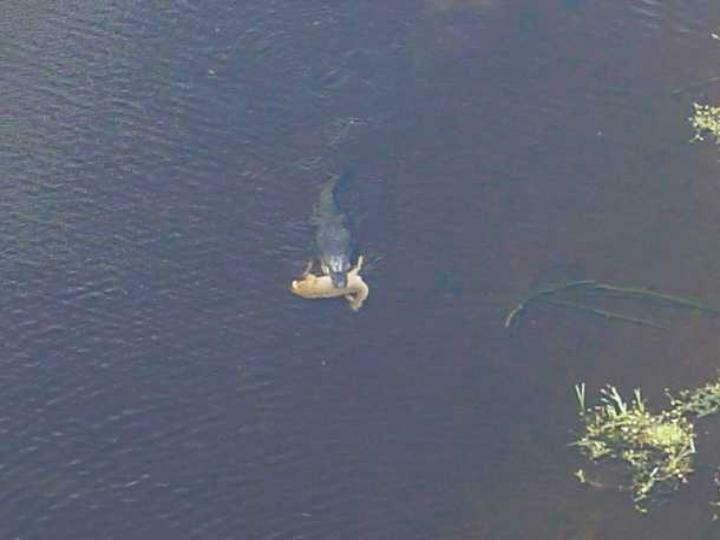
Claim:   Photos show an alligator swimming across a lake with a deer clutched in its jaws.

Status:   True. 

Example:   [Collected on the Internet, 2004] 


Water Skiing on Cross Lake

This was taken by a KTBS helicopter flying over Cross Lake! That has to be a HUGE gator to have a whole deer in its mouth! What do you think? Are you ready to go skiing on Cross Lake?! If you ski at the west end of the lake — try not to fall.

(For those of you who are not local, Cross Lake is in Shreveport, La. 30-40 miles from Marshall)

Click to enlargeClick to enlarge

Origins:   I really didn't care for venison the few times I tried it, but the gator in this picture appears to like it just fine.

These photographs of an alligator swimming across a lake with a deer clutched in its jaws circulated on the Internet in mid-2004, accompanied by several different versions of text crediting them to different sources:
  • A photographer flying over Cross Lake (or Lake Conroe) in a news helicopter belonging to TV station KTBS of Shreveport, Louisiana.

  • An "Alabama Forest Service guy on daily fire patrol" at Lake Martin, Alabama.

  • An employee of the Texas Forestry Commission took the photograph while flying in a helicopter with the South Carolina Forestry Commission.

  • A worker at the Kennedy Space Center in Florida.
The first explanation was out, as KTBS said they haven't had a newscopter since their chopper crashed in 1990, and Leslie Johnson with the Louisiana Department of Wildlife and Fisheries noted that the vegetation was all wrong and the water too clear to be Cross Lake. And officials with the Alabama Forestry Commission disclaimed the Lake Martin explanation:
Although the caption indicates that the alligator is in Lake Martin, officials at the Alabama Forestry Commission said that's not true.

"It's a legitimate photo, but it wasn't taken on Lake Martin," said Regina Miller, assistant to the state forestry commissioner. "It was taken in South Carolina, and I suppose someone thought it would be more interesting here if it was on Lake Martin, Alabama."

Jim Spradley, the pilot for the Tallapoosa County office of the state's forestry commission, said he too received the e-mail, but he was never fooled by the photo.

"I've got that e-mail myself, and as far as I know, I'm the only one who flies Lake Martin," he said. "I didn't take it."
In August 2004, the U.S. Fish & Wildlife Service (USFWS) finally cleared up the issue by issuing apress release identifying the photographs as having been taken in south Georgia (near the Georgia/South Carolina border) by a USFWS officer in March 2004:
The sight of a 12 to 14 foot-long alligator is something south Georgia folks see occasionally, but few have seen one take an adult deer out to lunch. Actually — for lunch.

The photographs of this deer-eating alligator were taken from the air by Terri Jenkins, a U.S. Fish and Wildlife Service District Fire Management Officer. She was preparing to ignite a prescribed fire at Harris Neck National Wildlife Refuge, about 40 miles south of Savannah, Georgia, on March 4,2004.

"One advantage of fire work is you get to see that 12-14 footers are common from Santee National Wildlife Refuge in South Carolina to Coastal South Carolina to Georgia’s coast," said Jenkins. "It looks like the alligator population is doing extremely well."

This one was at least 12-13 feet long. Jenkins said that some bull alligators have a 35 inch girth.
This version (which dates to August 2008) combines the 2004 alligator swimming with a deer in its mouth photos that were taken in Georgia with the 2005 photo of a large alligator that was killed in Texas, then places the whole thing in Alabama:
This picture was taken by a KTBS helicopter flying over Lake Wiess about 90 miles north of Birmingham, Alabama!

The helicopter pilot and the game warden were in communication via radio's here is a transcript of their conversation

'Air: 1 have you a visual on the gator, over'

'Approaching inlet now, over'

'Roger Air1'

'Gator sighted. Looks like it has a small animal in its mouth.. moving in, over'

'Roger Air1'

'Holy Crap it's a Deer!'

'confirm Air1.. did you say Deer?, Over'

'Roger.. a Deer in its mouth.. looks like a full sized buck.. that's a big gator, were gonna need more men, Over'

'Roger Air1..can you give me a idea on size of animal, over'

'Its big 25 feet at least, please advise Gator is heading to inlet.. do I pursue?, over'

That has to be a HUGE gator to have a whole deer in its mouth!

The deer was later found to be a mature Stag and was measured at 11 feet! Are you ready to go skiing on Lake Wiess?! If you ski at the west end of the lake — try not to fall.

This alligator was found between Centre and Leesburg, Alabama near a house! Game wardens were forced to shoot the alligator- guess he wouldn't cooperate...

Anita and Charlie Rogers could hear the bellowing in the night. Their neighbors had been telling them that they had seen a mammoth alligator in the waterway that runs behind their house, but they dismissed the stories as exaggerations.

'I didn't believe it,' Charles Rogers said, but they realized the stories were, if anything, understated.

Alabama Parks and Wildlife game wardens had to shoot the beast. Joe Goff, 6'5' tall, a game warden, walks past the 28-foot, 1-inch alligator he shot and killed in their back yard


Last updated:   9 July 2009

Urban Legends Reference Pages © 1995-2015 by snopes.com.
This material may not be reproduced without permission.
snopes and the snopes.com logo are registered service marks of snopes.com.
 
  Sources Sources:
    McAlister, Laura.   "Tale of Gator in Lake Is Just That."
    The Alexander City Outlook.   27 July 2004.
    KTBS-TV [Shreveport].   "Legend of the Deer-Eating Gator in Shreveport."
    KTBS-TV, 27 August 2004.
    U.S. Fish & Wildlife Service.   "Alligator Takes Deer to Lunch in South Georgia."
    23 August 2004.


Saturday, April 11, 2015

Pictures of Alligator Swimming with Dead Deer in Its Mouth


gator2-thumbnail


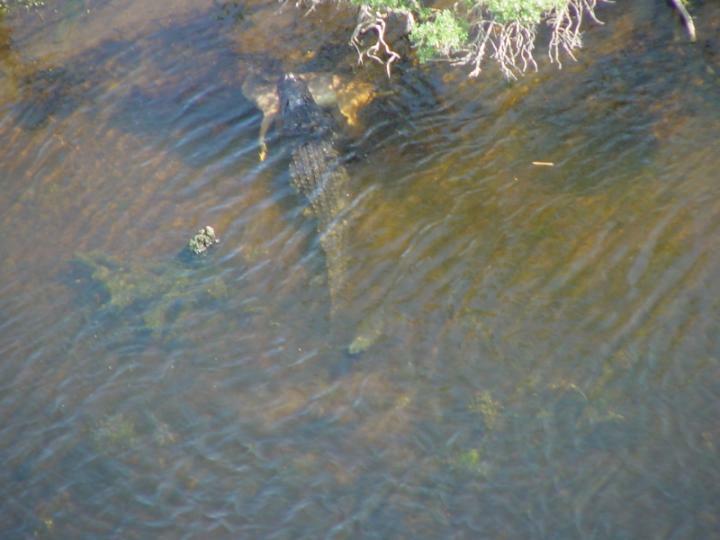
These pictures were taken in 2004 by Terri Jenkins, an officer of the U.S. Fish and Wildlife service over the Harris Neck National Wildlife Refuge about 40 miles South of Savannah, Georgia.

According to a news release, she was aboard a helicopter that was igniting prescribed fires in the refuge when the 12 to 13-foot alligator was spotted swimming with the full-grown deer in its mouth.


Source: http://www.truthorfiction.com/gator/


World's largest crocodile greets Dubai Mall visitors


Thursday, November 20, 2014

Giant Crocodiles - Return of Killer Crocodiles (History Channel Document...


Published on Sep 12, 2014
Giant Crocodiles - Return of Killer Crocodiles around the World (National Geographic Documentary)


___

animals attack humans,wild animals,crocodile attacks,crocodile vs deer,animal life,wildlife,deadly crocodiles,huge crocodile,giant crocodile,man eating crocodile,crocodile attack hippo,crocodile attack zebra,crocodile attack lion,crocidile vs cheetah,crocodile attack shark,crocodile attack at nile river,sahara desert,deadly crocodile attack,crocodile attack human,cheetahs attack crocodile,Crocodile (Animal), world largest crocodile, massive crocodile, deadly attack crocodile, “the animal planet” "bbc Natural World Documentary" “discovery channel documentary” "hbo documentaries" "history channel documentaries" "top documentary films" "great documentaries" "good documentaries" "fishing documentary" "pbs documentaries" "national geographic documentary" "full documentary Wild" "tlc documentary" "discovery education” “knowledge based document” "documentary channel” "bbc2 documentary" “National Geographic documentary” "bbc documentary" "animal planet documentary" "nat geo wilde channel" "wildlife documentary"


+-+-+-+-+-+-+

Please Subscribe Our New Channel https://www.youtube.com/user/TheChann...