ESTUARY EXPERTS

ESTUARY EXPERTS

Wednesday, August 19, 2015

Boy and a Beach Ball Posing On A Crocodile


Posing On A Crocodile


Saturday, July 18, 2015

Great Blue Heron Fishing


This series of photos shows a Great Blue Heron fishing a catfish out of this canal. It trundled over the small hill and when out of site started hollering as if the prey bit back (some fish have horns, like bull heads I've caught, that can give you a nasty cut when you go to hurl them back into water).


//


Monday, April 13, 2015

Huge Gator with full-grown Stag


Snopes is a good place to validate information you find on the Internet.  The deer is a full grown stag they say is 11 feet long (?)

Source: http://www.snopes.com/photos/animals/gatordeer.asp

Gatorade

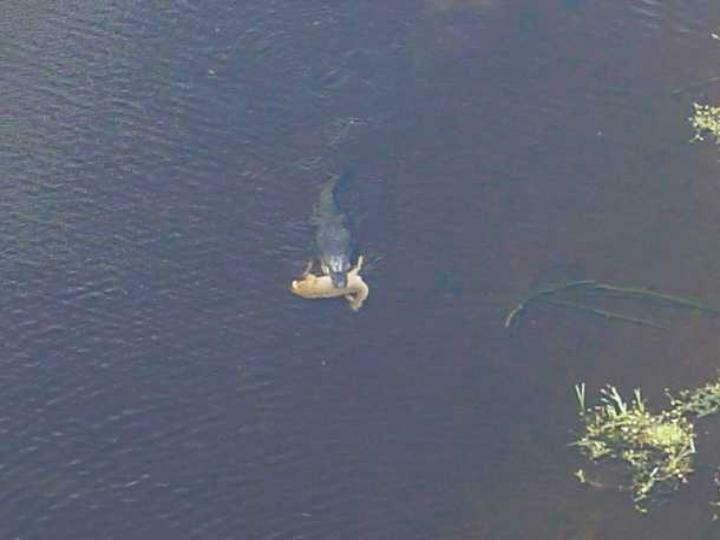
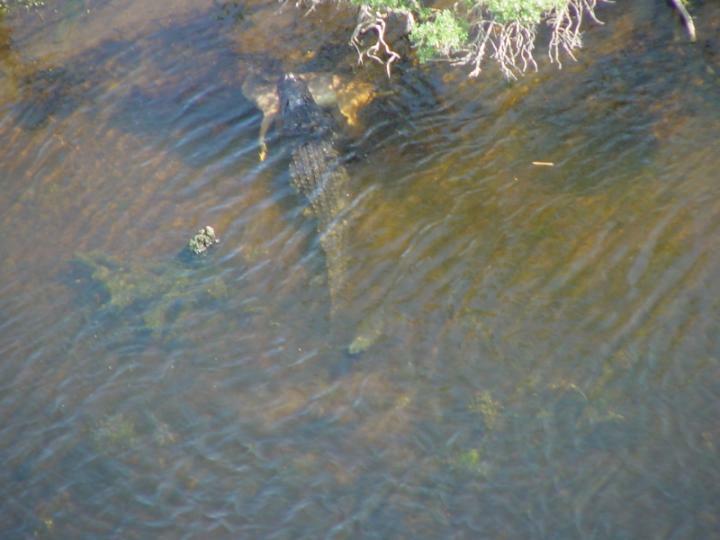
Claim:   Photos show an alligator swimming across a lake with a deer clutched in its jaws.

Status:   True. 

Example:   [Collected on the Internet, 2004] 


Water Skiing on Cross Lake

This was taken by a KTBS helicopter flying over Cross Lake! That has to be a HUGE gator to have a whole deer in its mouth! What do you think? Are you ready to go skiing on Cross Lake?! If you ski at the west end of the lake — try not to fall.

(For those of you who are not local, Cross Lake is in Shreveport, La. 30-40 miles from Marshall)

Click to enlargeClick to enlarge

Origins:   I really didn't care for venison the few times I tried it, but the gator in this picture appears to like it just fine.

These photographs of an alligator swimming across a lake with a deer clutched in its jaws circulated on the Internet in mid-2004, accompanied by several different versions of text crediting them to different sources:
  • A photographer flying over Cross Lake (or Lake Conroe) in a news helicopter belonging to TV station KTBS of Shreveport, Louisiana.

  • An "Alabama Forest Service guy on daily fire patrol" at Lake Martin, Alabama.

  • An employee of the Texas Forestry Commission took the photograph while flying in a helicopter with the South Carolina Forestry Commission.

  • A worker at the Kennedy Space Center in Florida.
The first explanation was out, as KTBS said they haven't had a newscopter since their chopper crashed in 1990, and Leslie Johnson with the Louisiana Department of Wildlife and Fisheries noted that the vegetation was all wrong and the water too clear to be Cross Lake. And officials with the Alabama Forestry Commission disclaimed the Lake Martin explanation:
Although the caption indicates that the alligator is in Lake Martin, officials at the Alabama Forestry Commission said that's not true.

"It's a legitimate photo, but it wasn't taken on Lake Martin," said Regina Miller, assistant to the state forestry commissioner. "It was taken in South Carolina, and I suppose someone thought it would be more interesting here if it was on Lake Martin, Alabama."

Jim Spradley, the pilot for the Tallapoosa County office of the state's forestry commission, said he too received the e-mail, but he was never fooled by the photo.

"I've got that e-mail myself, and as far as I know, I'm the only one who flies Lake Martin," he said. "I didn't take it."
In August 2004, the U.S. Fish & Wildlife Service (USFWS) finally cleared up the issue by issuing apress release identifying the photographs as having been taken in south Georgia (near the Georgia/South Carolina border) by a USFWS officer in March 2004:
The sight of a 12 to 14 foot-long alligator is something south Georgia folks see occasionally, but few have seen one take an adult deer out to lunch. Actually — for lunch.

The photographs of this deer-eating alligator were taken from the air by Terri Jenkins, a U.S. Fish and Wildlife Service District Fire Management Officer. She was preparing to ignite a prescribed fire at Harris Neck National Wildlife Refuge, about 40 miles south of Savannah, Georgia, on March 4,2004.

"One advantage of fire work is you get to see that 12-14 footers are common from Santee National Wildlife Refuge in South Carolina to Coastal South Carolina to Georgia’s coast," said Jenkins. "It looks like the alligator population is doing extremely well."

This one was at least 12-13 feet long. Jenkins said that some bull alligators have a 35 inch girth.
This version (which dates to August 2008) combines the 2004 alligator swimming with a deer in its mouth photos that were taken in Georgia with the 2005 photo of a large alligator that was killed in Texas, then places the whole thing in Alabama:
This picture was taken by a KTBS helicopter flying over Lake Wiess about 90 miles north of Birmingham, Alabama!

The helicopter pilot and the game warden were in communication via radio's here is a transcript of their conversation

'Air: 1 have you a visual on the gator, over'

'Approaching inlet now, over'

'Roger Air1'

'Gator sighted. Looks like it has a small animal in its mouth.. moving in, over'

'Roger Air1'

'Holy Crap it's a Deer!'

'confirm Air1.. did you say Deer?, Over'

'Roger.. a Deer in its mouth.. looks like a full sized buck.. that's a big gator, were gonna need more men, Over'

'Roger Air1..can you give me a idea on size of animal, over'

'Its big 25 feet at least, please advise Gator is heading to inlet.. do I pursue?, over'

That has to be a HUGE gator to have a whole deer in its mouth!

The deer was later found to be a mature Stag and was measured at 11 feet! Are you ready to go skiing on Lake Wiess?! If you ski at the west end of the lake — try not to fall.

This alligator was found between Centre and Leesburg, Alabama near a house! Game wardens were forced to shoot the alligator- guess he wouldn't cooperate...

Anita and Charlie Rogers could hear the bellowing in the night. Their neighbors had been telling them that they had seen a mammoth alligator in the waterway that runs behind their house, but they dismissed the stories as exaggerations.

'I didn't believe it,' Charles Rogers said, but they realized the stories were, if anything, understated.

Alabama Parks and Wildlife game wardens had to shoot the beast. Joe Goff, 6'5' tall, a game warden, walks past the 28-foot, 1-inch alligator he shot and killed in their back yard


Last updated:   9 July 2009

Urban Legends Reference Pages © 1995-2015 by snopes.com.
This material may not be reproduced without permission.
snopes and the snopes.com logo are registered service marks of snopes.com.
 
  Sources Sources:
    McAlister, Laura.   "Tale of Gator in Lake Is Just That."
    The Alexander City Outlook.   27 July 2004.
    KTBS-TV [Shreveport].   "Legend of the Deer-Eating Gator in Shreveport."
    KTBS-TV, 27 August 2004.
    U.S. Fish & Wildlife Service.   "Alligator Takes Deer to Lunch in South Georgia."
    23 August 2004.


Saturday, April 11, 2015

Pictures of Alligator Swimming with Dead Deer in Its Mouth


gator2-thumbnail


These pictures were taken in 2004 by Terri Jenkins, an officer of the U.S. Fish and Wildlife service over the Harris Neck National Wildlife Refuge about 40 miles South of Savannah, Georgia.

According to a news release, she was aboard a helicopter that was igniting prescribed fires in the refuge when the 12 to 13-foot alligator was spotted swimming with the full-grown deer in its mouth.


Source: http://www.truthorfiction.com/gator/


World's largest crocodile greets Dubai Mall visitors


Thursday, November 20, 2014

Giant Crocodiles - Return of Killer Crocodiles (History Channel Document...


Published on Sep 12, 2014
Giant Crocodiles - Return of Killer Crocodiles around the World (National Geographic Documentary)


___

animals attack humans,wild animals,crocodile attacks,crocodile vs deer,animal life,wildlife,deadly crocodiles,huge crocodile,giant crocodile,man eating crocodile,crocodile attack hippo,crocodile attack zebra,crocodile attack lion,crocidile vs cheetah,crocodile attack shark,crocodile attack at nile river,sahara desert,deadly crocodile attack,crocodile attack human,cheetahs attack crocodile,Crocodile (Animal), world largest crocodile, massive crocodile, deadly attack crocodile, “the animal planet” "bbc Natural World Documentary" “discovery channel documentary” "hbo documentaries" "history channel documentaries" "top documentary films" "great documentaries" "good documentaries" "fishing documentary" "pbs documentaries" "national geographic documentary" "full documentary Wild" "tlc documentary" "discovery education” “knowledge based document” "documentary channel” "bbc2 documentary" “National Geographic documentary” "bbc documentary" "animal planet documentary" "nat geo wilde channel" "wildlife documentary"


+-+-+-+-+-+-+

Please Subscribe Our New Channel https://www.youtube.com/user/TheChann...


Tuesday, October 7, 2014

This Crab Stood Up To A Very Big Alligator


Bold, Brave or Crazy?


gator

South Carolina resident Phil Lanoue photographed the moment the crab and the gator faced off in what could have been a battle to the death -- for the crab, anyway. But when it heard the giant reptile approaching from behind, Lanoue saw the wee crustacean wheel around and pinch the alligator on the snout.  The crab then scuttled safely away... " Caters News Agency wrote.


This Crab Stood Up To A Very Big Alligator -- And Won:

http://www.huffingtonpost.com/2014/10/06/crab-vs-alligator-photo-pinches_n_5940560.html?&ncid=tweetlnkushpmg00000048

'via Blog this'

Sunday, September 14, 2014

Year's Best Attack - Jaguar Attacks Crocodile

ublished on Feb 27, 2014
The amazing jaguar, Panthera onca, is the only Panthera species found in the Americas and is the third-largest feline after the tiger and the lion by a close amount. Could the jaguar take on a lion or tiger? Like the tiger, the jaguar is largely a solitary, ambush predator that also likes water.


However, the jaguar has an exceptionally powerful bite even as it is compared to other big cats. The jaguar has the ability to enact a killing skill that could be considered more effective: it can bite directly through the skull of its prey, between the ears to deliver a fatal bite to the brain. Unlike alternately trying to go for the neck, windpipe or jugular, the ability to bite right through the skull gives the Jaguar an edge.


In this MaxAnimal analysis of one of the year's best attacks caught on camera, the jaguar does just that and pierces the brain by biting through the temple bone. Check out the amazing footage and cool info and analysis by MaxAnimal.


Also, check out more great wild animal clips, information, and MaxAnimal stuff at our YouTube Channel:


www.youtube.com/maxxanimal

Site:

www.maxanimal.com

Facebook:

https://www.facebook.com/maxsocialanimal

Twitter:

https://twitter.com/MaxSocialAnimal

Follow us on Instagram - http://instagram.com/maxanimal/

Follow us on Google+ - https://plus.google.com/1060202931713...


Thursday, August 28, 2014

Jaws of Death: Crocodile

Jaws of Death: A crocodile emerges from the water and uses its powerful jaw to clasp hold of an unlucky turtle on the remote Osa Peninsula in south-western Costa Rica

Jaw-dropping: The gut-wrenching moment a crocodile burst from the sea to snatch a turtle by the head 

  • Mexican photographer Alejandro Prieto captured dramatic scenes in Corcovado National Park, south-west Costa Rica
  • He had hoping to see bull sharks on the trip and was taken by surprise when the huge crocodile burst from the sea
  • After hiding in the jungle and setting up his camera he managed to catch the turtle's sad final moments

Jaws of Death: A crocodile emerges from the water and uses its powerful jaw to clasp hold an unlucky turtle by the head

This is the gut-wrenching moment a crocodile burst from the sea to snatch an unlucky turtle by the head as it ventured back into the water.

The huge reptile emerged from the waves to clamp its fearsome jaws around the slow-moving amphibian on the sand.
Photographer Alejandro Prieto captured the incredible scenes on the remote Osa Peninsula in south-western Costa Rica.

Scroll down for video 
Jaws of Death: A crocodile emerges from the water and uses its powerful jaw to clasp hold of an unlucky turtle on the remote Osa Peninsula in south-western Costa Rica
No hope: The dramatic kill was unexpectedly captured by wildlife photographer Alejandro Prieto, 37, of Guadalajara, Mexico,  who is also trained as a vet

No hope: The dramatic kill was unexpectedly captured by wildlife photographer Alejandro Prieto, 37, of Guadalajara, Mexico,  who is also trained as a vet
The area forms part of Corcovado National Park, which is bordered by the Pacific Ocean and the Gulf of Dulce.
Mr Prieto, 37, from Guadalajara, Mexico, is trained as a vet but has been photographing wildlife for six years.
He said: 'It was a very hot morning. I was walking through the beach hoping to see a bull shark, which is something common in this area.
'They usually feed close to the river mouth, local people told me they had seen some the day before.
'From nowhere I heard a loud sound coming from the sea, at the moment I did not know what was happening, but after a few minutes I saw a huge crocodile emerging from the sea.

Fearsome: Seconds away from death, the turtle is completely helpless after being caught in the jaws of the massive crocodile inside Corcovado National Park, Costa Rica


'It was a bigger surprise when I saw it struggling with large green turtle.
'I quickly hid myself in the jungle - around 15 metres from the scene - hoping not to interfere and watch them fight for a few minutes.
'Luckily I managed a few photos before the crocodile went back to the ocean with the turtle inside its mouth.'
After half-an-hour, the crocodile swam along the surface where he was joined by a bull shark - thought to be attracted by the scent of the turtle's blood. 


Wednesday, March 5, 2014

Snake Eats Crocodile


Snake devours crocodile after five-hour battle

A huge python ingests an entire crocodile after a fight to the death with the reptile in Australia


After a long-fought battle in Australia, a python bested a crocodile and swallowed the reptile whole.

Bystanders Marvin Muller and Tiffany Corlis managed to capture photos of the snake eating the crocodile over a span of several hours in Queensland.

The snake reportedly fought the croc for five hours in Lake Moondarra. Winning the fight, the python constricted its prey to death. The estimated 10-foot snake then dragged the 3-foot croc ashore and proceeded to swallow it whole in front of a group of onlookers.

"We saw the snake fighting with the crocodile -- it would roll the crocodile around to get a better grip, and coil its body around the crocodile's legs to hold it tight," Corlis said, describing the scene to BBC News. "After the crocodile had died, the snake uncoiled itself, came around to the front, and started to eat the crocodile, face-first."

 python croc 1


 python croc 2


 python croc 3


National Geographic identified the snake as an olive python and the croc as a Johnson's crocodile, both of which are native to Australia.
While it may look like the python took on too big of a meal, snake expert Bryan Fry of the University of Queensland’s School of Biological Science said it's not uncommon for a python to take on a croc of this size.
"Crocs are more dangerous to catch but easier to sneak up on," Fry told the Brisbane Times. "The problem is they are risking being injured or killed, so they have to be judicious."
After its hefty meal, the python should be full for at least a month.


 Source:  http://www.huffingtonpost.com/2014/03/04/snake-eats-crocodile-swallows-croc-australia-photos_n_4896644.html


Thursday, January 23, 2014

Jaguar Attacks Crocodile EXCLUSIVE VIDEO


 published on Sep 26, 2013


When a jaguar pounces, sometimes one
bite is all it takes to get a meal. National Geographic has exclusive
video of a jaguar taking down a caiman in Brazil's Pantanal wetlands,
photos of which went viral earlier this month. Luke Dollar, a
conservation scientist who helps manage National Geographic's Big Cats
Initiative, explains the hunt and explosive moment of predation.


Read the article from National Geographic News:

http://news.nationalgeographic.com/ne...


VIDEOGRAPHERS: Kedar Hippalgaonkar and Parul Jain

NARRATOR: Luke Dollar

EDITOR: Will Halicks

SPECIAL THANKS: Jason Kurtis

RESEARCH: Joe Lemeris

Tuesday, December 10, 2013

Whooping Crane Video

Whooping Cranes-Texas Parks and Wildlife [Official]


License:  Standard YouTube License

Sunday, December 8, 2013

Crocodiles Lure Birds

Crocodiles Balance Twigs on Their Heads to Lure Nest-Building Birds

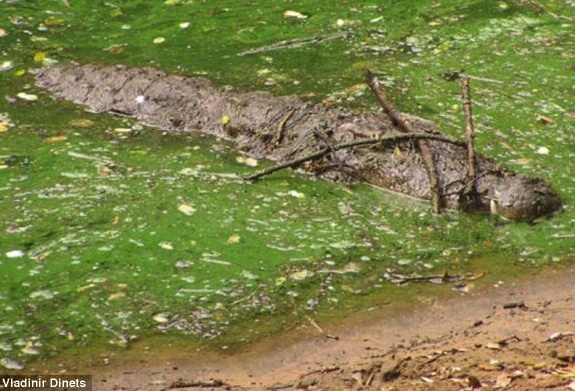
Photo: Vladimir Dinets

Many predators have built-in lures for tricking prey. Snapping turtles’ tongues look like worms. Anglerfish grow glowing protrusions that lure smaller first directly towards their mouths. It is the truly clever predator, however, that uses tools fashioned from the environment to snag a meal. Chimps use sticks to harvest ants, dolphins use sponges to stir up the seafloor and, researchers have now discovered, mugger crocodiles balance sticks and twigs across their snouts—just around breeding season for water birds.

Working in India, the researchers observed that the crocs would situate themselves in shallow waters near the shore and do their best impression of a log. When the unsuspecting birds waded too close—presumably enticed by those nice sticks, perfect for nest-making—the crocs would lunge.

To verify whether these actions spanned species and were timed to the birds’ breeding season, the researchers set up observation stations of American alligators in Louisiana. Wired explains what they saw:
The researchers found that the occurrence of sticks on crocodilians was not random. It was more often seen in those reptiles living near the bird nests and was only witnessed during the nesting season. Of course, it could be that floating sticks randomly find themselves atop a croc’s nose, but the researchers say that floating sticks are extremely rare in the waters observed. This means that it’s more likely that the reptiles are deliberately collecting and using the twigs as bait. If this is the case, it would be described as tool use.
While crocodiles and alligators are stereotypically seen as “lethargic, stupid and boring,” study author Vladimir Dinets says, he hopes their newly discovered tool-using skills will bring greater appreciation to the cunning crocodilians.

Source:  Smithsonianmag.com

Saturday, December 7, 2013

Crocodiles Balance Twigs on Their Heads to Lure Nest-Building Birds


Crocodiles balance twigs on their heads to lure in birds that are building nests: 


December 5, 2013 12:05 pm

Crocodiles Balance Twigs on Their Heads to Lure Nest-Building Birds 

Many predators have built-in lures for tricking prey. Snapping turtles’ tongues look like worms. Anglerfish grow glowing protrusions that lure smaller first directly towards their mouths. It is the truly clever predator, however, that uses tools fashioned from the environment to snag a meal. Chimps use sticks to harvest ants, dolphins use sponges to stir up the seafloor and, researchers have now discovered, mugger crocodiles balance sticks and twigs across their snouts—just around breeding season for water birds.
Working in India, the researchers observed that the crocs would situate themselves in shallow waters near the shore and do their best impression of a log. When the unsuspecting birds waded too close—presumably enticed by those nice sticks, perfect for nest-making—the crocs would lunge.
To verify whether these actions spanned species and were timed to the birds’ breeding season, the researchers set up observation stations of American alligators in Louisiana. Wired explains what they saw:
The researchers found that the occurrence of sticks on crocodilians was not random. It was more often seen in those reptiles living near the bird nests and was only witnessed during the nesting season. Of course, it could be that floating sticks randomly find themselves atop a croc’s nose, but the researchers say that floating sticks are extremely rare in the waters observed. This means that it’s more likely that the reptiles are deliberately collecting and using the twigs as bait. If this is the case, it would be described as tool use.
While crocodiles and alligators are stereotypically seen as “lethargic, stupid and boring,” study author Vladimir Dinets says, he hopes their newly discovered tool-using skills will bring greater appreciation to the cunning crocodilians.


More from Smithsonian.com:
Worst Vacation Ever? Man Trapped on Island for Two Weeks by Crocodile
Ocean Currents Are Highways for Crocodiles


 Link: 
 http://blogs.smithsonianmag.com/smartnews/2013/12/crocodiles-balance-twigs-on-their-heads-to-lure-nest-building-birds/?fb_action_ids=622881621108194&fb_action_types=og.likes&fb_ref=.UqPv-CkDB00.like&fb_source=other_multiline&action_object_map=[1457927074434564]&action_type_map=[%22og.likes%22]&action_ref_map=[%22.UqPv-CkDB00.like%22]


Alligator and Blue Heron


Published on Mar 23, 2012 by

The Big alligator it is look at me!!! - YouTube

http://www.youtube.com/watch?v=Bikfdm10_vQ&feature=plcp


elassawipo's channel: 560 videos of animals

http://www.youtube.com/user/elassawipo/videos?sort=dd&view=0&page=2


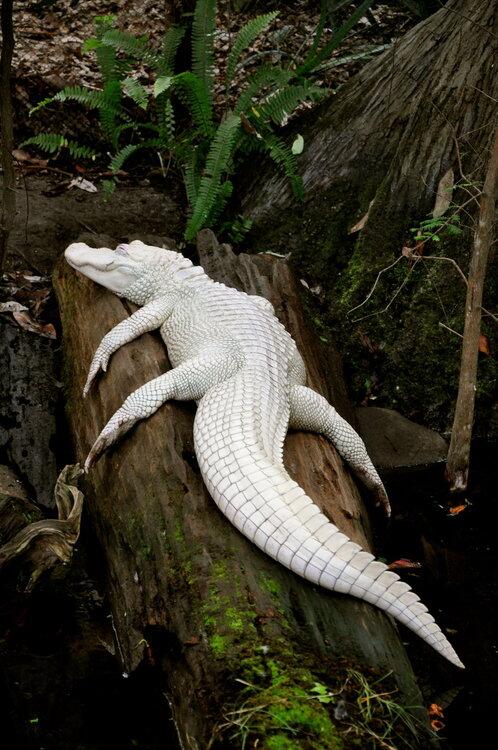
An Albino Crocidile

Embedded image permalink

Tuesday, November 26, 2013

A WRONG TURN


Rare Asian bird takes "wrong turn," lands in Tennessee

An Asian hooded crane is seen at the Hiwassee Refuge in Tennessee in an undated handout photo. REUTERS/John Kuehnel/Handout
An Asian hooded crane is seen at the Hiwassee Refuge in Tennessee in an undated handout photo.

(Reuters) - A rare Asian hooded crane, normally seen only in Southeast Asia, China and Japan, apparently "took a wrong turn" and has joined sandhill cranes wintering at the Hiwassee Refuge in southeast Tennessee, bird experts say, drawing flocks of curious birdwatchers along with it.

"It's a great thrill," said Melinda Welton, conservation chair for the Tennessee Ornithological Society and a bird migration researcher. "People are coming in from all over the country to see this bird."


Welton said local birdwatcher Charles Murray has been keeping a log of visitors to the town of Birchwood, near the Tennessee Wildlife Resources Agency refuge.


"He has had more than 700 people come and visit from all over the country to see this bird," she said. "People have come from 26 states and from two countries, including Russia."
The bird has been seen every day since mid-December, when the sandhill cranes arrived for their winter residency at the refuge.


Welton said this particular type of crane "nests in southern Russia and northern China and winters in Japan."


The TWRA said in a release that more than 8,000 of the hooded cranes - approximately 80 percent of the world's population of the species - winter on the Japanese island of Kyushu.
Welton said it is unlikely that the bird escaped from captivity, since there are no bands or other markings. Instead she said it's probably a happy freak occurrence that brought it to Tennessee.


"There have been other records of birds that take a wrong turn," she said. "And now that he's on the North American continent, it looks like he's associating with his closest relatives."
In addition to the Asian crane and the flock of sandhills, whooping cranes are wintering at the refuge.


"This is the highlight of the century for southeast Tennessee," said local birder Tommie Rogers.


"Likely there have never been three different crane species visible in the wild east of the Mississippi River before."


Bald eagles also are a common sight at the refuge that is about a 45-minute drive north or Chattanooga.

Monday, November 25, 2013

New York Sewer Alligators


Are Alligators living under New York City (Documentary)

                 
Published on Jun 10, 2013
A look back at a story from the 1930s that a swarm of alligators was found living in the sewers under New York City, and a new delve into the sewer system to see if the creatures could still be lurking there.

Sewer alligator stories date back to the late 1920s and early 1930s; in most instances they are part of contemporary legend. They are based upon reports of alligator sightings in rather unorthodox locations, in particular New York City.

Following the reports of sewer alligators in the 1930s, the story has built up over the decades and become more of a contemporary legend. Many have even questioned the extent of truth in the original stories, some even suggesting it to be fiction and that Teddy May's creative mind may have contributed to the tales. However, the story of the 'Sewer Gator' in New York City is well known and various versions have been told.

Some versions go further to suggest that, after the alligator was disposed of at such a young age, it would live the majority of its life in an environment not exposed to sunlight, and thus it would apparently in time lose its eyesight and the pigment in its hide and that the reptile would grow to be completely albino, pure white in color with red eyes. Another reason why an albino alligator would retreat to an underground sewer is because of its vulnerability to the sun in the wild, as there is no dark pigment in the creature's skin, it has no protection from the sun, which makes it very hard for it to survive in the wild.

There are numerous recent media accounts of alligators occupying storm drains and sewer pipes:

However, herpetologists believe that a sewer is not a fit environment for any alligator, and they would be unlikely to be able to reproduce. The animals need warm temperatures all year round, as opposed to the frigid cold of the Sewer Systems

  • License  Standard YouTube License